Photography — SG-CN-017
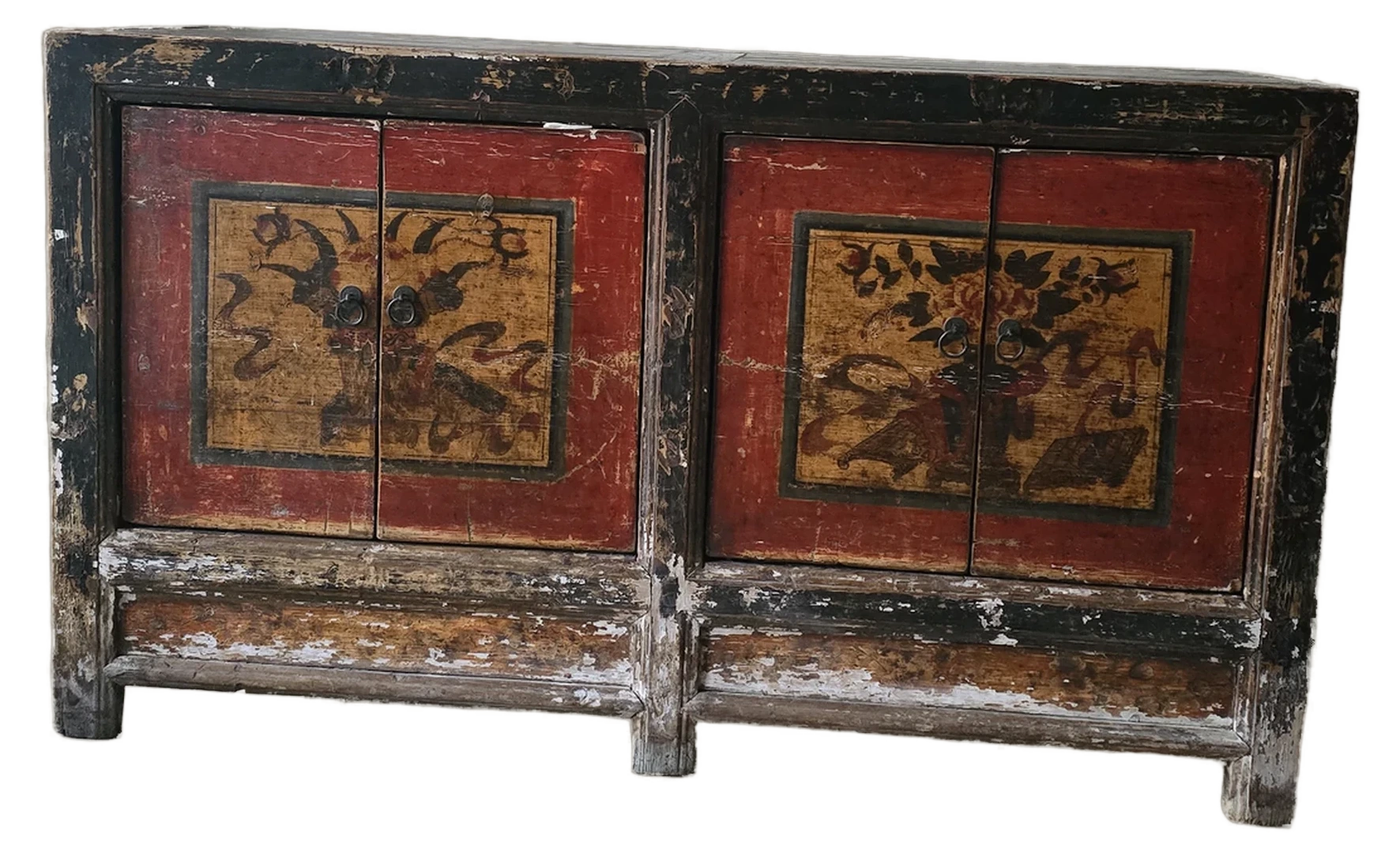
Stitt Gallery · SG-CN-017 · China 🇨🇳
Original Surface · Unrestored · Single Piece
The Cabinet
A substantial storage cabinet from Shanxi Province, Northern China, retaining its original painted decoration in the vernacular caihui (彩繪) tradition — a cinnabar-red ground with ochre-yellow painted panels and black outline work, applied directly to a pine/elm softwood carcass. This is domestic provincial furniture rather than fine hardwood scholar's-studio work, and the decoration is the piece's whole character: bold, hand-painted, and unmistakably regional.
The cabinet opens on two doors fitted with original hand-forged iron ring pulls, to a two-level interior — one storage tier above, one below. The painted surface has been cleaned and loose flaking stabilised, but is otherwise entirely unrestored: the craquelure, scattered paint loss and edge wear are original, accumulated honestly over the piece's working life. The style is consistent with the late Qing–early Republic period, c.1880–1930; we present this as a stylistic observation rather than a certified or documented date.
At 145cm wide and a low 82cm high, it reads as a substantial floor piece — a sideboard, credenza or storage chest depending on how it's used — with enough presence to anchor a room while still sitting low and horizontal in the Northern Chinese vernacular manner.
Specifications
| Style | Shanxi provincial, caihui polychrome |
| Period | Style consistent with c.1880–1930, unattributed |
| Origin | Shanxi Province, Northern China |
| Height | 82 cm |
| Width | 145 cm |
| Depth | 52 cm |
| Materials | Pine/elm softwood, natural-pigment lacquer, iron hardware |
| Configuration | Two doors; two-level interior (one shelf up, one down) |
| Condition | Cleaned and stabilised; original unrestored painted surface |
| Design Affinity | Wabi-sabi · Japandi · warm minimalism |
| Price | €2,150 |
| Gallery Ref | SG-CN-017 |
Condition
In the market for Chinese provincial furniture, original surface is the exception rather than the rule — many pieces reaching Europe have been repainted or refinished to look newer than they are. This cabinet wasn't. The craquelure across the cinnabar ground, the wear around the iron pulls, and the softened top surface are original, accumulated over more than a century of use in Shanxi. They aren't damage to be corrected; they're the evidence that this is what it claims to be.
We cleaned the carcass and stabilised loose paint from behind. We did not repaint, re-lacquer, or artificially age it. The surface you see is the surface that survived.
Design Affinity
This cabinet is Chinese provincial, from Shanxi — not Japanese. We use "wabi-sabi" deliberately rather than loosely: it names the specific quality this piece has and a repainted or reproduction cabinet doesn't — a surface that shows its own history instead of hiding it, cracked and worn honestly rather than restored to look new. "Japandi" names the material register it sits in once it's in a Western room: natural wood, muted earth tones, uncluttered horizontal lines, the same family as linen, oak, concrete and stone. Neither term claims Japanese origin for a Chinese object; both describe how this piece actually behaves in a room.
That's the brief we see most often from the interior designers we work with across Berlin, Poznań and the wider European market: a low, wide, quietly commanding piece that reads as collected rather than sourced from a catalogue — the opposite of a mass-produced "Japandi-style" reproduction cabinet, because it is neither Japandi nor a reproduction. At 145cm wide and a low 82cm high, it works as a grounding presence beside a sofa, under a large piece of art, or as a credenza in a dining room. The cinnabar lacquer warms a neutral palette; the worn frame keeps it from looking staged. It reads as collected, not purchased.
The more precise vocabulary for it, though, is Chinese, not Japanese. This is guzhuo (古拙) — the rustic, slightly asymmetric beauty of a piece built for a merchant's household rather than the Forbidden City, which is exactly why it survived intact instead of being remade for display. The wear pattern is ziran (自然): unforced, accumulated rather than applied, the kind of surface a workshop cannot convincingly fake. We'd call it less a piece of furniture than a qi wu (器物) — a crafted object that held a household's daily ritual for over a century before it holds anything of ours.
Three Ways to Search For This Cabinet
This is what wabi-sabi actually looks like before the word became a moodboard caption: an unrestored, hand-painted caihui surface with genuine 140-year-old craquelure, not a distressed finish applied to make something new look old. Style it the way the philosophy asks — alone, undecorated, a single ceramic piece on top at most. The imperfection is the point; don't compete with it.
Pair it with pale oak flooring, a linen sofa and a low platform bed, and let this be the one dark, storied anchor in an otherwise quiet, pale palette — Japandi's Scandinavian half needs exactly one object with this much history in it, or the room reads as empty rather than calm. Use it as a credenza under a piece of art, or a sideboard against a plain wall; the cinnabar and ochre carry the room's warmth on their own.
Not every buyer needs a design label for it. If you're after a genuine, untouched Asian antique — original surface, original hand-forged iron pulls, a documented Shanxi provenance rather than a vague "vintage Chinese" listing — this is that piece, priced as the provincial furniture it actually is, not as an imperial-grade museum piece.
Photography — SG-CN-017
Construction & Detail
Hand-painted cinnabar and ochre panels, unrestored — caihui, the defining vernacular tradition of Shanxi domestic furniture, applied by hand rather than through fine inlay or carving. Every crack in the lacquer is original, not reproduced.
Pine and elm, not fine scholar-class hardwood — a straightforward, functional carcass typical of provincial workshop production. That practical construction, with the painted surface carrying the decorative weight, is characteristic of furniture built for daily domestic use rather than display.
Two doors open to a two-level interior — generous enough for linens, tableware or archives. The shelf is original and load-bearing, a straightforward, practical configuration for domestic storage.
The ring pulls are original iron, set directly into the painted wood and worn smooth by handling. Their slight asymmetry is consistent with hand-forging rather than a cast, factory-made fitting.
We stabilised loose paint from behind. We did not repaint, refresh, or add artificial age. Craquelure, scattered paint loss and edge wear are original and left as found — what you see is what survived, and that's increasingly rare in this category.
Low and wide, at 145cm by a modest 82cm high, it anchors a wall without dominating it. Works as a sideboard, media console or bedroom storage — the painted front reads as a statement from across the room.
Living With This Piece
As a sideboard: pair with a linen sofa and a single ceramic vase — the cinnabar lacquer warms grey and oatmeal tones without overwhelming them.
As a bedroom chest: the low 82cm height works under a window or at the foot of a bed, with the interior shelf keeping linens dust-free.
As a statement: in a hallway or landing, the painted front faces the room on entry — the first thing a guest notices, and the last thing they forget.
Provincial, not imperial. Made to be used, not admired behind rope.
This piece forms part of our collection of European and Asian antiques available at Stitt Gallery, Poznań.
€2,150
We welcome enquiries from collectors, interior specialists and institutions. Viewing by appointment in Poznań. Please enquire for a shipping quote to your destination.
Secure online payment via Stripe · card · Google Pay
Gallery reference: SG-CN-017 · stittgallery.com
Continue browsing