Photography
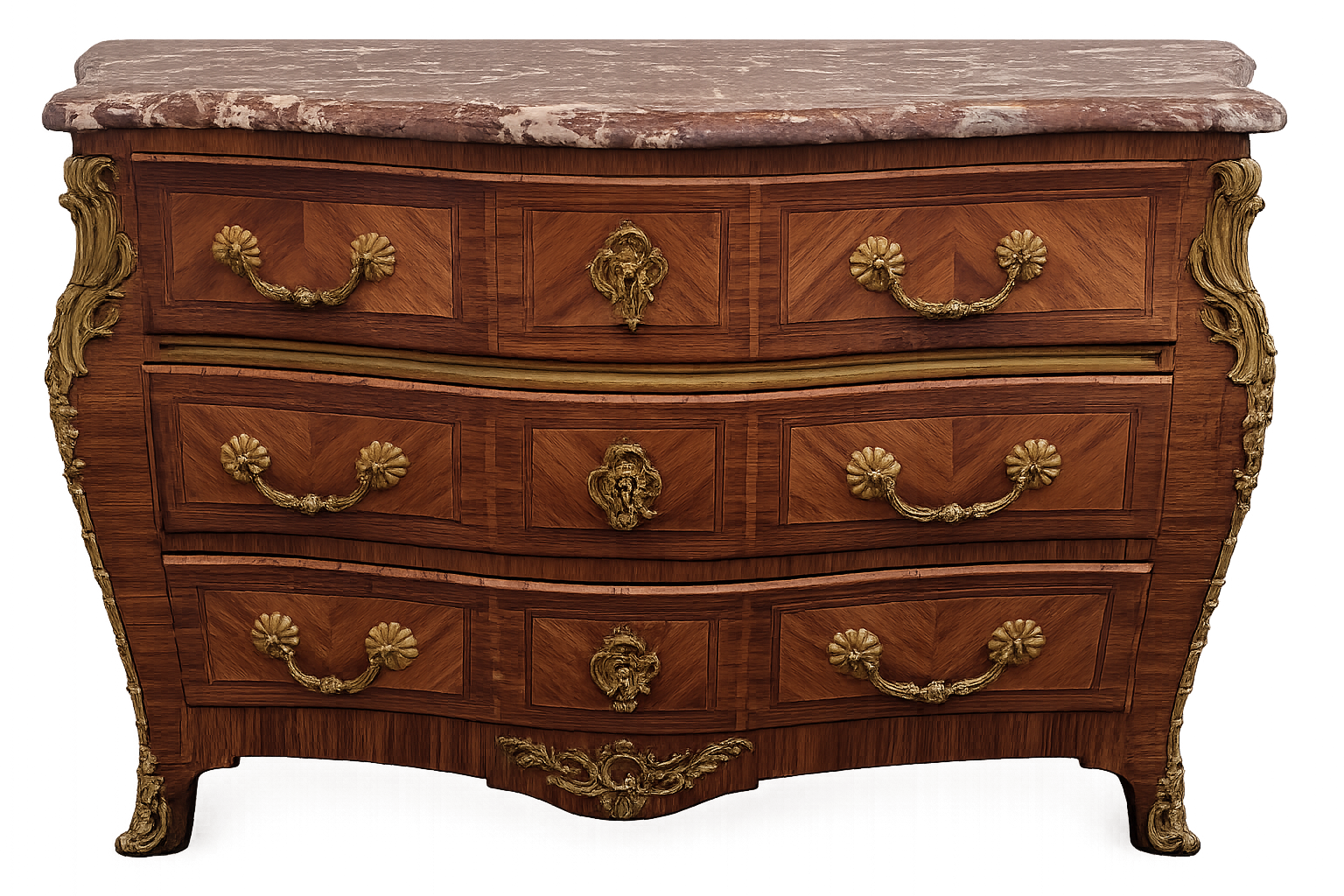
Stitt Gallery · SG-FR-001 · France
Louis XV Revival, Paris c.1860–1880
The Piece
This is a commode of exceptional width — a substantial statement of 19th-century Parisian cabinetmaking that spans 133 cm in kingwood, tulipwood and Rouge Griotte marble. At 90 cm height it follows the classic Louis XV proportion, but its 133 cm width dominates the wall with aristocratic horizontal presence.
Produced by the Chardonnay atelier in Paris during the Second Empire or early Third Republic period, c.1860–1880, the commode is constructed on a quarter-sawn oak carcase veneered in rich kingwood and tulipwood parquetry, following the Régence tradition of crossbanding and counterchange marquetry. The bombé form is pronounced and confident — wider than comparable workshop examples.
The single unjoined slab of Rouge Griotte de l'Hérault marble — with its characteristic oeil de perdrix patterning — rests uncut across the full 133 cm width, 30 mm in depth. This is a mark of quality that significantly distinguishes this piece within its category.
Specifications
| Height | 90 cm |
| Width | 133 cm |
| Depth | 58 cm |
| Period | c.1860–1880 Second Empire / Early Third Republic |
| Atelier | Chardonnay, Paris |
| Primary Materials | Kingwood (Bois de Violette) & Tulipwood (Bois de Rose) |
| Secondary Materials | Quarter-sawn oak carcase |
| Marble | Rouge Griotte de l'Hérault Single slab, unjoined — 30 mm |
| Mounts | Hand-chiselled gilded ormolu bronze |
| Stamp Count | 4 × CHARDONNAY estampilles |
| Stamp Format | Circular, with fleur-de-lys — one at each corner |
| Drawer Configuration | 4 drawers, 3 rows — all with original locks |
| Parquetry | Kingwood & tulipwood crossbanding with counterchange marquetry |
| Gallery Ref | SG-FR-001 |
| Country | France |
Photography
The Maker
Chardonnay was a Parisian cabinetmaker active in the second half of the 19th century, specialising in Louis XV–Régence Revival furniture of exceptional quality. Christopher Payne’s Paris Furniture (2018) documents Chardonnay on page 281, placing the atelier firmly within the circle of respected makers working in the Régence Revival idiom during the Second Empire and Third Republic periods.
The Chardonnay atelier is not to be confused with the grandest names of the period — Sormani, Dasson, or Millet — but rather occupies a distinguished middle tier: producing work of genuine quality with correct materials, proper construction, and consistent attention to period detail, without the premium commanded by the most celebrated makers.
| Maker | Period | Price Range (Commodes) | Relative Position |
|---|---|---|---|
| Paul Sormani | c.1847–1888 | €60,000 – €150,000+ | Premier tier — gold medal, Exposition Universelle |
| Théodore Millet | c.1853–1918 | €50,000 – €120,000 | Premier tier — Maison Millet, Bd Beaumarchais |
| Chardonnay | c.1860–1880 | €18,000 – €55,000 | Distinguished mid-tier — excellent value |
| Unsigned / Generic | c.1860–1900 | €8,000 – €20,000 | Commercial production, variable quality |
Sources: Payne, C. Paris Furniture (2018) p.281; auction results 2019–2024 from Tajan, Piasa, Aguttes, Christie's.
Materials & Construction
Every material used in this commode was chosen with deliberate intent. From the selection of the marble slab to the pairing of kingwood and tulipwood, the atelier demonstrated knowledge of both period convention and practical craftsmanship.
Primary Veneer
A dense, fine-grained hardwood from the Dalbergia cearensis species native to Brazil. Kingwood takes its name from its historical use in royal furniture. Its deep violet-brown tone with black striations provides the dominant ground for the parquetry. The timber was among the most prized imported hardwoods in 19th-century Parisian cabinetmaking.
Secondary Veneer
Dalbergia decipularis from Brazil, prized for its delicate pink to salmon tones with darker veining. Tulipwood provides the lighter contrast strips in the crossbanding and marquetry details. Its use alongside kingwood is characteristic of the finest Régence Revival work, where tonal contrast between dark and light exotic timbers was essential.
The Royal Marble
Quarried in the Hérault department of southern France, this deep crimson marble with its characteristic oeil de perdrix (partridge eye) spotting was reserved for the finest furniture commissions. The slab on this commode is a single, unjoined piece spanning the full 133 cm width — a clear indicator of quality commissioning rather than commercial production, where narrower offcuts were commonly joined.
Fire-gilded Bronze
All bronze mounts — corner sabots, drawer pulls, key escutcheons, and the apron cartouche — are hand-chiselled gilded ormolu. The mercury gilding process, though largely supplanted by electroplating by the 1860s, was still employed by specialist Parisian bronze founders for pieces of quality. The chasing quality and gilding depth are consistent with mid-to-upper tier Second Empire work.
| Material | Scientific Name | Origin | Application | Quality Indicator |
|---|---|---|---|---|
| Kingwood | Dalbergia cearensis | Brazil | Primary parquetry ground | Finest veneer grade, quarter-cut |
| Tulipwood | Dalbergia decipularis | Brazil | Crossbanding & contrast | Pink-salmon tone, clear grain |
| Rouge Griotte | Calcitic marble | Hérault, France | Top slab | Single slab, unjoined, 30mm |
| Ormolu bronze | Cu-Zn-Au alloy | Paris foundries | Mounts & fittings | Hand-chiselled, mercury gilded |
| Oak carcase | Quercus robur | France | Structural frame | Quarter-sawn for stability |
Construction Analysis
The construction method confirms workshop authenticity through three independent characteristics: the removable marble design, component-matching stamps, and traditional drawer construction.
Design Feature
The marble sits freely on the oak carcase with no adhesive bonding. This was standard practice in 19th-century Parisian ateliers — it permitted transport in sections, cleaning, and future verification. The fact that the marble can still be freely removed after 140+ years confirms no later intervention has occurred. A replacement marble would typically be bonded with modern adhesive.
Workshop Practice
Roman numeral stamps ("G IV" and "IV D") on the oak carcase match corresponding marks on drawer components. This indicates workshop assembly from pre-cut, pre-veneered components — each piece fitted to its specific position. Not mass-produced: every component was individually matched, a hallmark of quality atelier work.
Drawer Construction
All drawers feature hand-cut dovetail joints with the characteristic slight irregularity of handwork. Original brass locks are present on all four drawers. Oak drawer sides with beech runners follow traditional French construction methods of the period. The variation in dovetail spacing confirms 19th-century workshop production rather than machine manufacture.
Oak Carcase
The carcase is constructed from quarter-sawn oak (Quercus robur), chosen for its dimensional stability and resistance to warping. The oak shows tool marks consistent with hand-planing. Mortise-and-tenon joinery throughout provides a rigid, square frame with no joint movement after 140+ years.
What the underside documentation proves: (1) The marble is the original atelier marble — not a replacement. (2) It was assembled with the carcase in the Chardonnay workshop c. 1860–1880. (3) The original construction method (removable, no adhesive) has been preserved intact. (4) The blue chalk signature is a workshop mark applied before assembly — not a later addition. (5) The period hand-saw marks confirm 19th-century extraction and dressing, not modern diamond-wire cutting.
Condition Assessment
Each major component has been assessed individually. The overall condition is Good to Very Good for a piece of this age, with original materials substantially intact and no structural concerns. The recent marble underside documentation (May 2026) confirmed the original atelier construction method.
| Component | Rating | Notes |
|---|---|---|
| Marble top | Excellent | Single slab, no cracks or repairs. Minor surface patina consistent with age. Original Chardonnay signature visible on underside. |
| Veneer | Good | Kingwood and tulipwood parquetry substantially intact. Minor lifting at drawer edges, consistent with use. No significant losses. |
| Ormolu mounts | Good | Original gilding with attractive patina. Some tarnishing on apron cartouche. Chasing detail well preserved. No losses or replacements. |
| Drawer runners | Good | Original oak runners, functional. Minor wear consistent with age and use. All drawers open smoothly. |
| Drawer bases | Good | Original pine or oak bases intact. No splits or warping. Roman numeral assembly marks clearly visible. |
| Carcase structure | Excellent | Quarter-sawn oak frame is sound and rigid. No joint movement, warping, or structural compromise. All four estampilles legible. |
| Stamp legibility | Excellent | All four CHARDONNAY estampilles are clearly readable with fleur-de-lys detail distinct. No over-stamping or wear obscuring the marks. |
Provenance & Documentation
Stitt Gallery maintains full transparency regarding the provenance and documentation status of every piece. The following represents our complete knowledge record for SG-FR-001.
Professional Note
The Chardonnay commode illustrated in Christopher Payne's Paris Furniture: the luxury market of the 19th century (Editions Monelle Hayot, 2018), page 281, provides the closest documented comparable to SG-FR-001.
Payne writes: "Little is known about this maker. He seems to have specialised in copies of Regence-style commodes in kingwood and rosewood. The commode shown here is stamped four times with his family name interspersed with fleur-de-lys." And further: "The proportions of this commode clearly indicate that it is an adaptation of the Regence style, reduced in size for late nineteenth-century convenience."
While Payne's illustrated example was "reduced in size" — a common adaptation for Parisian apartments — SG-FR-001 maintains a substantial scale at 133 cm wide and 90 cm high. This suggests our piece may have been a custom commission for a grand interior rather than a standard catalogue piece. The single unjoined Rouge Griotte marble slab of this width supports the bespoke interpretation.
| Feature | Payne Comparable (p. 281) | SG-FR-001 (This Piece) |
|---|---|---|
| Style | Regence Revival | Louis XV / Regence Revival |
| Materials | Kingwood and rosewood | Kingwood, tulipwood, Rouge Griotte marble |
| Stamps | 4 x CHARDONNAY + fleur-de-lys | 4 x CHARDONNAY + fleur-de-lys |
| Form | Bombe tombeau | Bombe tombeau |
| Size | "Reduced" (smaller than period) | Full size: 133 cm wide, 90 cm high |
| Marble | Not specified | Rouge Griotte de l'Herault, single slab |
| Status | Published comparable | Available — Stitt Gallery |
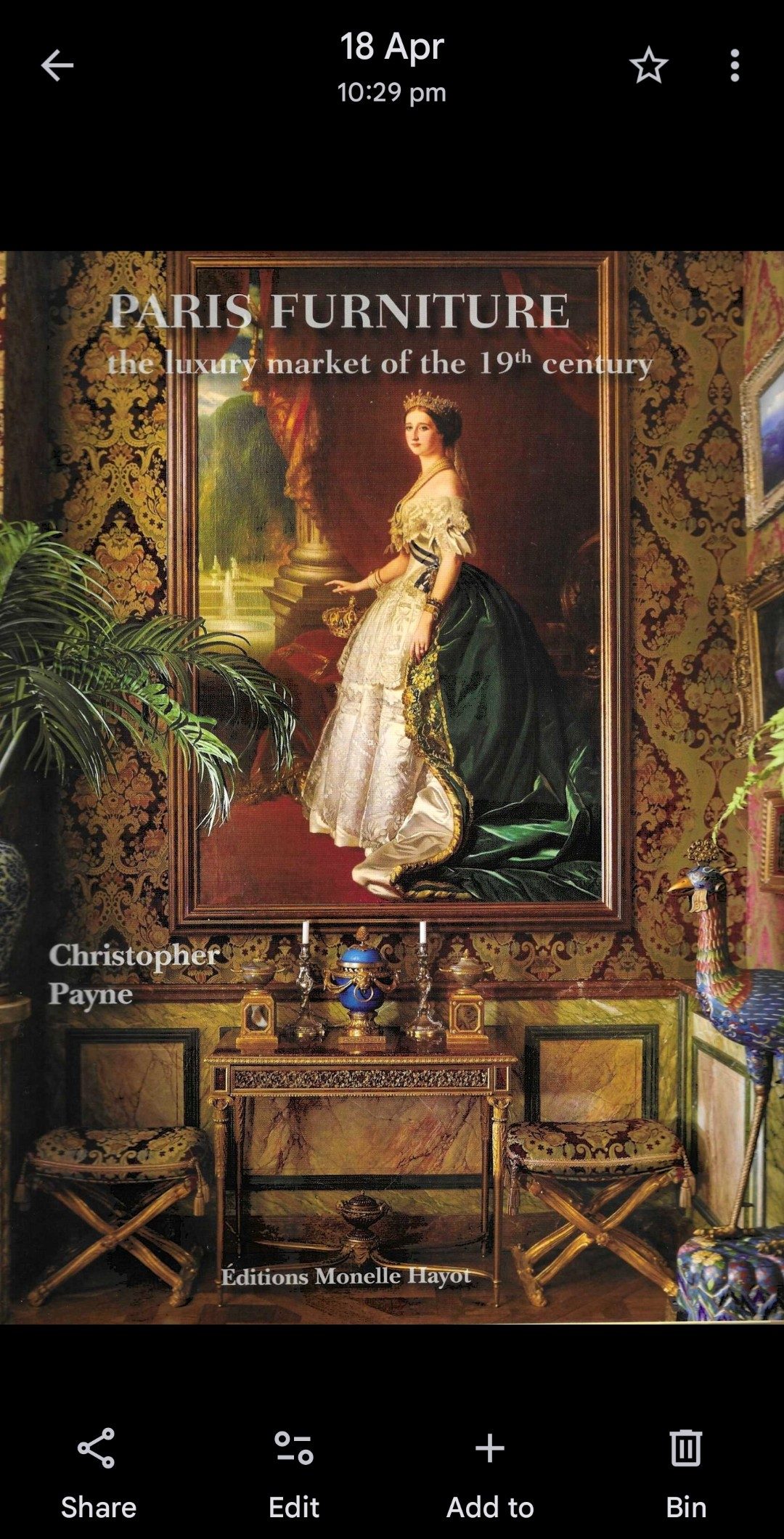
Payne, Paris Furniture (2018) — front cover
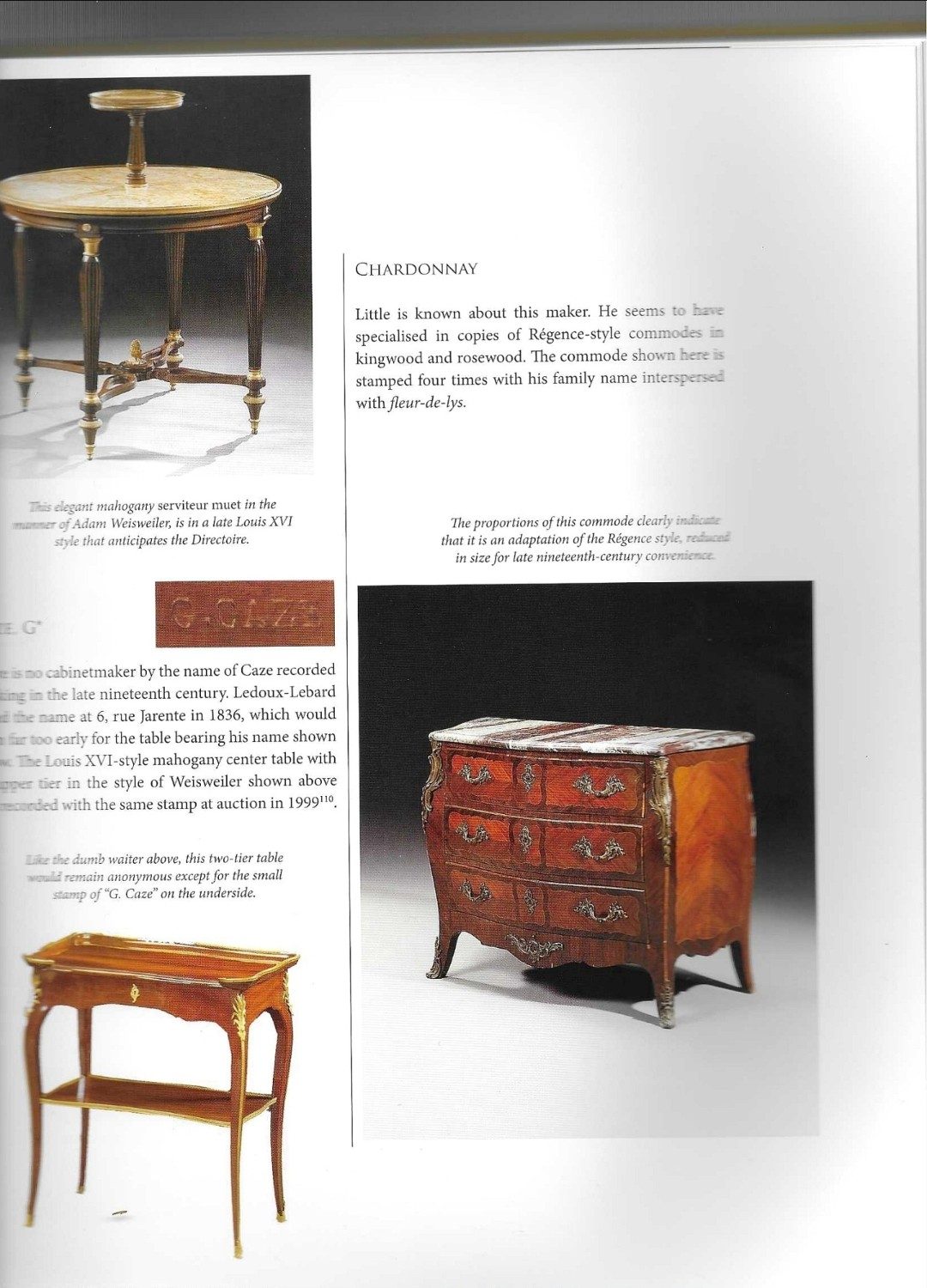
Page 281 — Chardonnay entry (reproduced by permission)
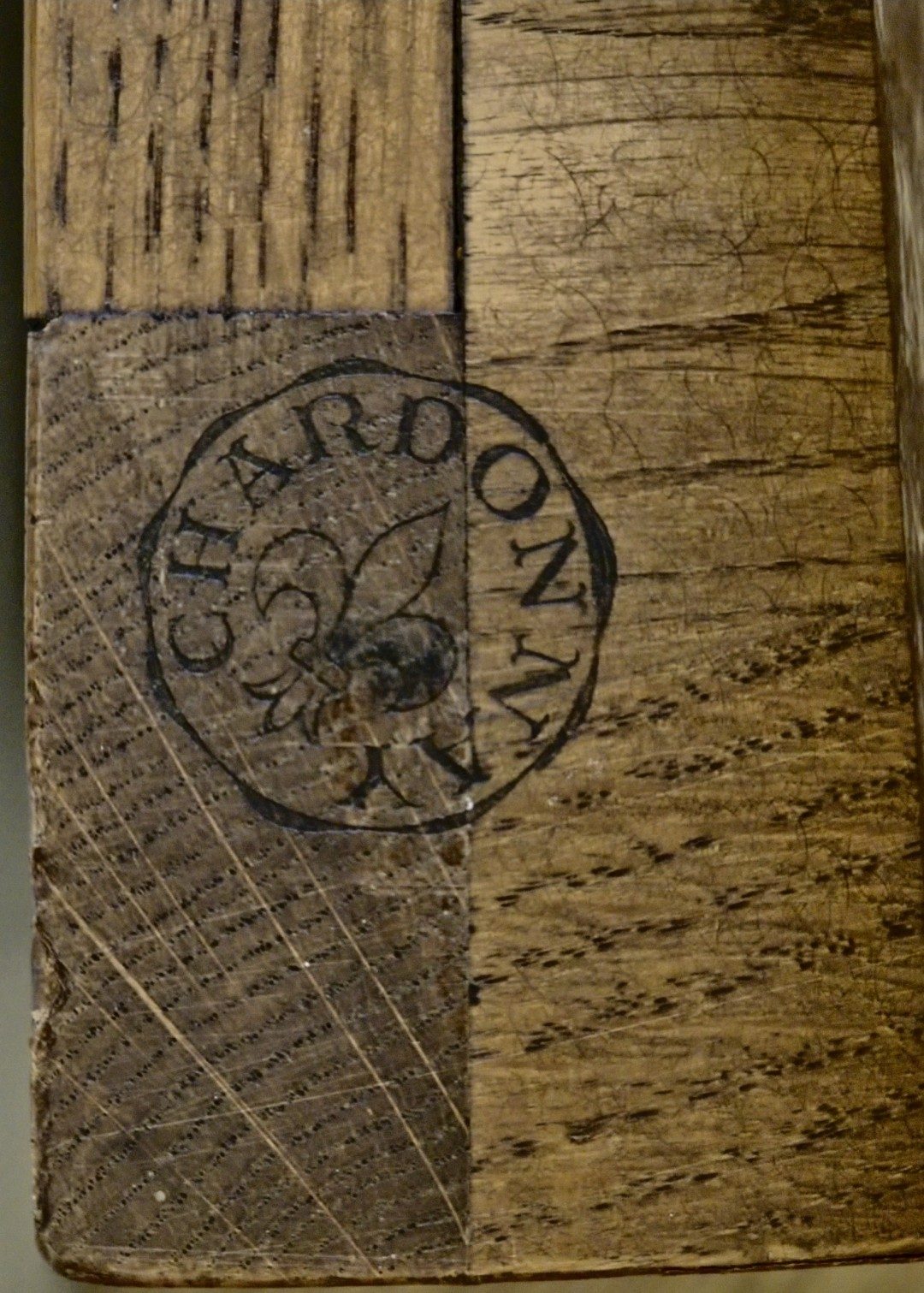
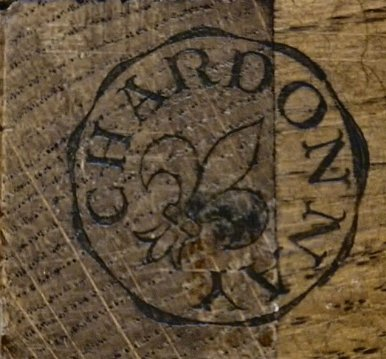
CHARDONNAY circular estampille with fleur-de-lys — primary attribution evidence
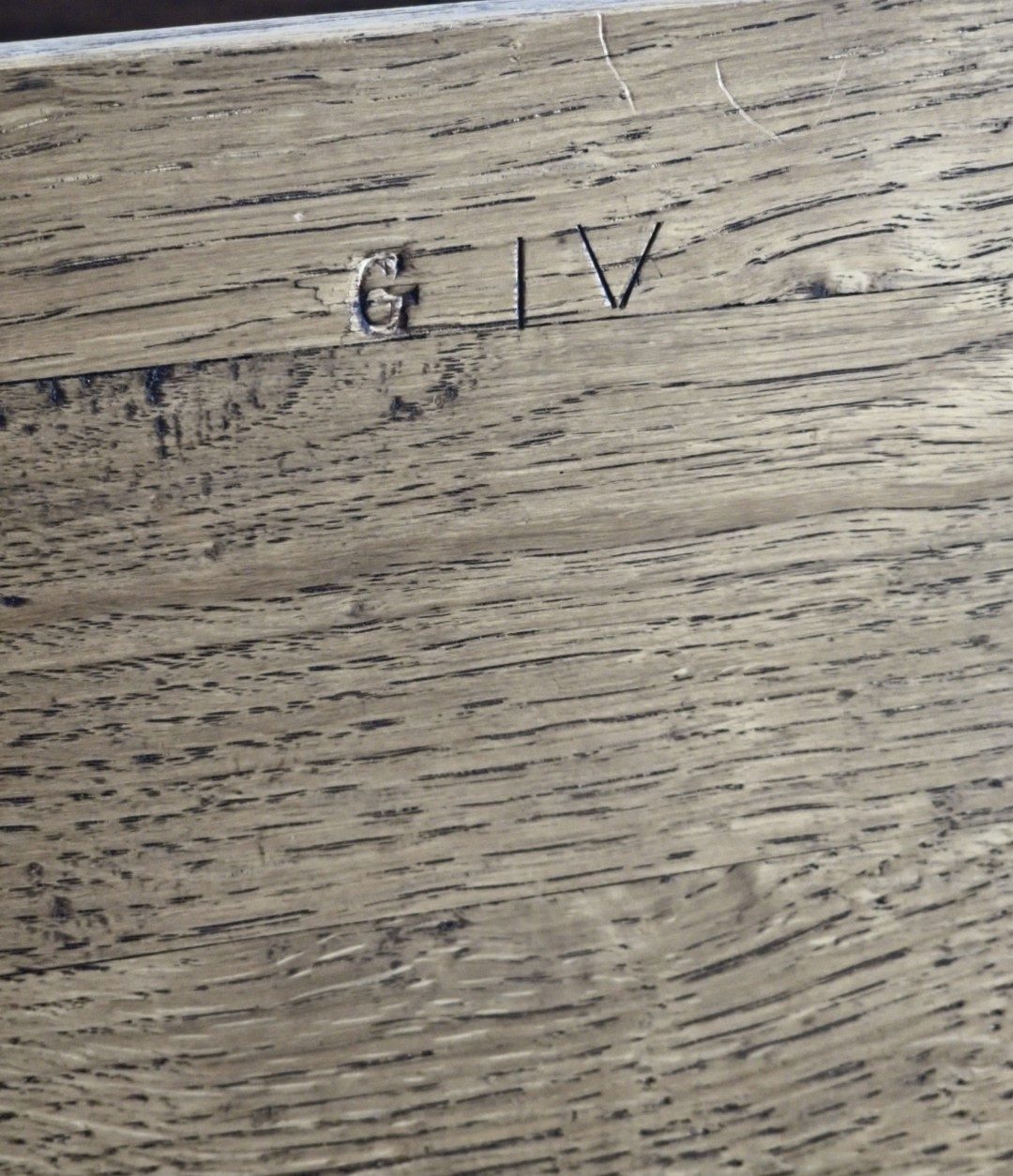
Workshop mark "G IV" — oak carcase
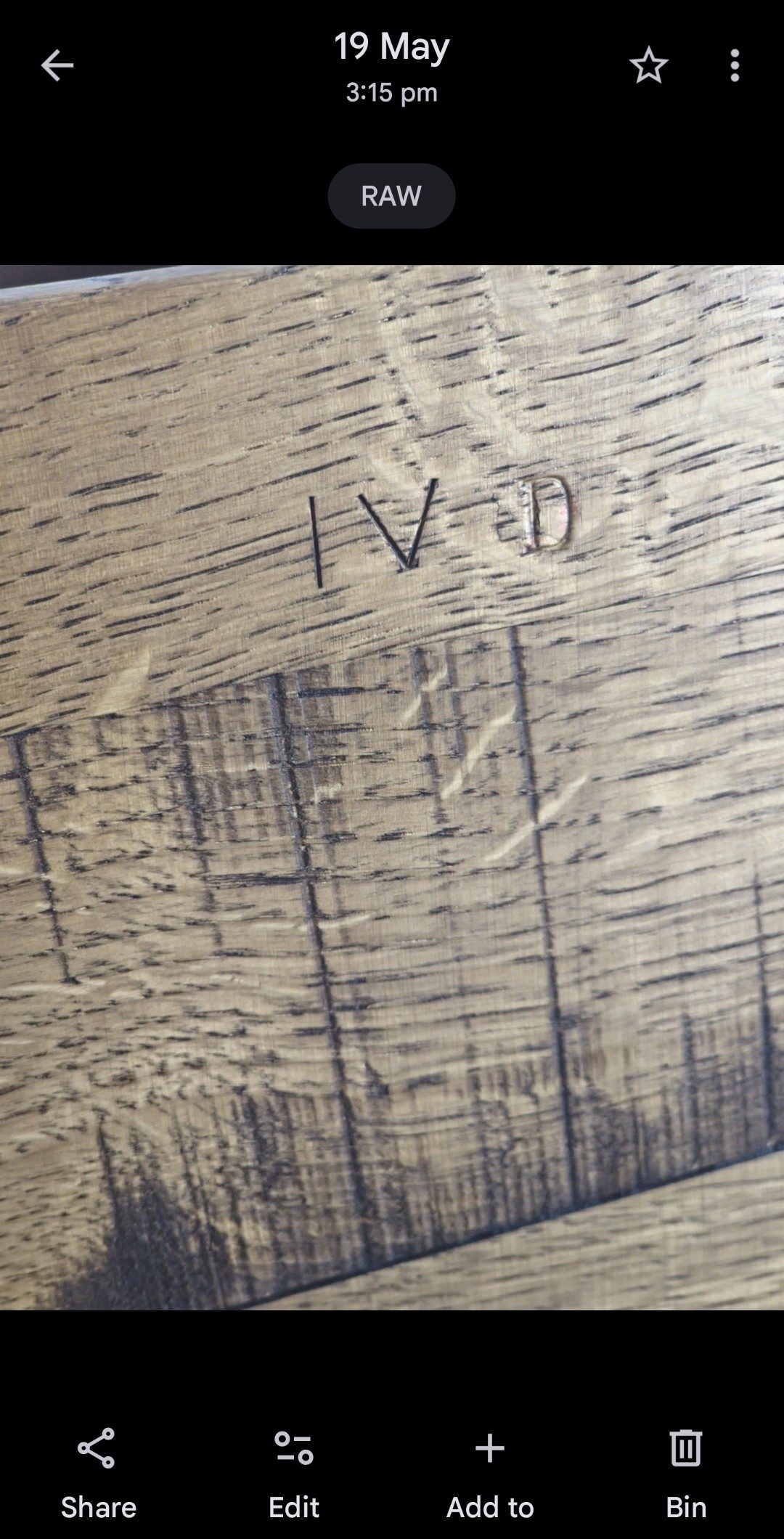
Workshop mark "IV D" — oak carcase
Source: Christopher Payne, Paris Furniture: the luxury market of the 19th century (Editions Monelle Hayot, 2018), p. 281. The comparable commode photograph and stamp detail inset are reproduced from the published work under scholarly reference.
Marble Authentication
The Rouge Griotte de l'Herault marble top has been analysed for construction authenticity. Six independent indicators confirm that the slab is a single, unjoined piece, original to the commode.
Indicator 1
The white and grey veining flows uninterrupted across the entire 133 cm width, following natural geological patterns. No breaks, offsets, or pattern disruptions are visible anywhere on the surface.
Indicator 2
No visible join lines, seams, filler strips, or colour-matching patches across the full surface or any edge. The perimeter is uniformly shaped with a consistent moulded profile.
Indicator 3
Measured at 30 mm consistently across the entire slab. No variation suggesting lamination, build-up, or later re-surfacing. The underside is uniformly raw and unfinished.
Indicator 4
The "Chardonnay" blue chalk signature is written freely in cursive across the centre of the underside with no interruption. It would be impossible to execute seamlessly across a joint — confirming one continuous piece.
Indicator 4b
Parallel diagonal cutting traces are visible across the entire underside — consistent with 19th-century pit-saw technique. These are NOT the smooth parallel marks left by modern diamond-wire saws. The saw marks continue uninterrupted across the full surface, confirming single-block extraction and period dressing.
Indicator 5
Natural saw marks are visible across the entire underside in a consistent direction. These are 19th-century cutting marks — not modern diamond-wire traces — and they continue uninterrupted across the full surface.
Indicator 6
The shaped and moulded edge follows the serpentine outline uniformly without breaks, changes in character, or evidence of piecemeal assembly. The profile is continuous and consistent.
Confidence Level: 95% — HIGH. The marble top is a single, unjoined slab of Rouge Griotte de l'Herault marble, original to the commode, cut to the full 133 cm width from one block. The blue chalk "Chardonnay" signature and period hand-saw marks on the underside are primary authentication assets — physical evidence of original atelier assembly rarely encountered in 19th-century furniture. A single slab of this width in this quality represents a significant material investment, indicating bespoke commissioning rather than commercial production.
Full Technical Report
The following professional report was prepared by Stitt Gallery based on comprehensive photographic documentation (16+ images), physical examination, and scholarly research. It is published here in full as part of our commitment to transparent disclosure.
Report reference: SG-FR-001-TECH-2026 · Date: 15 May 2026
SG-FR-001 carries six independent markers confirming its attribution to the Chardonnay atelier:
| # | Evidence | Location | Significance |
|---|---|---|---|
| 1 | 4 estampilles | Each corner of carcase top rail | Primary attribution. Circular CHARDONNAY stamp with fleur-de-lys centre. Matches documented practice per Payne p.281. |
| 2 | Blue chalk signature + period hand-saw marks | Underside (raw face) of marble | Primary authentication asset. "Chardonnay" in blue chalk cursive + parallel diagonal pit-saw cutting traces consistent with 19th-century technique. Documented May 2026. Would not be present on a replacement marble. |
| 3 | Roman numeral marks | Drawer components | Assembly marks I-IV confirm original hand manufacture and original drawer-to-carcase matching. |
| 4 | Single marble slab | Top surface and underside | Unjoined Rouge Griotte spanning 133 cm indicates bespoke commissioning, consistent with documented Chardonnay quality. |
| 5 | Period construction | Throughout | Hide glue, quarter-sawn oak, machine-sawn veneer, mercury-gilded bronze — all consistent with c.1860-1880 Parisian production. |
| 6 | Scholarly documentation | Payne, Paris Furniture (2018) p.281 | The commode matches the style, materials, and stamping practice described by the acknowledged authority on 19th-century Parisian furniture. |
Authentication Confidence: HIGH (95%) — All six independent evidence markers are mutually consistent and point to a genuine Chardonnay atelier production from the Second Empire or early Third Republic period. The marble underside documentation (blue chalk signature + period hand-saw marks, May 2026) provides rare primary evidence of original atelier assembly.
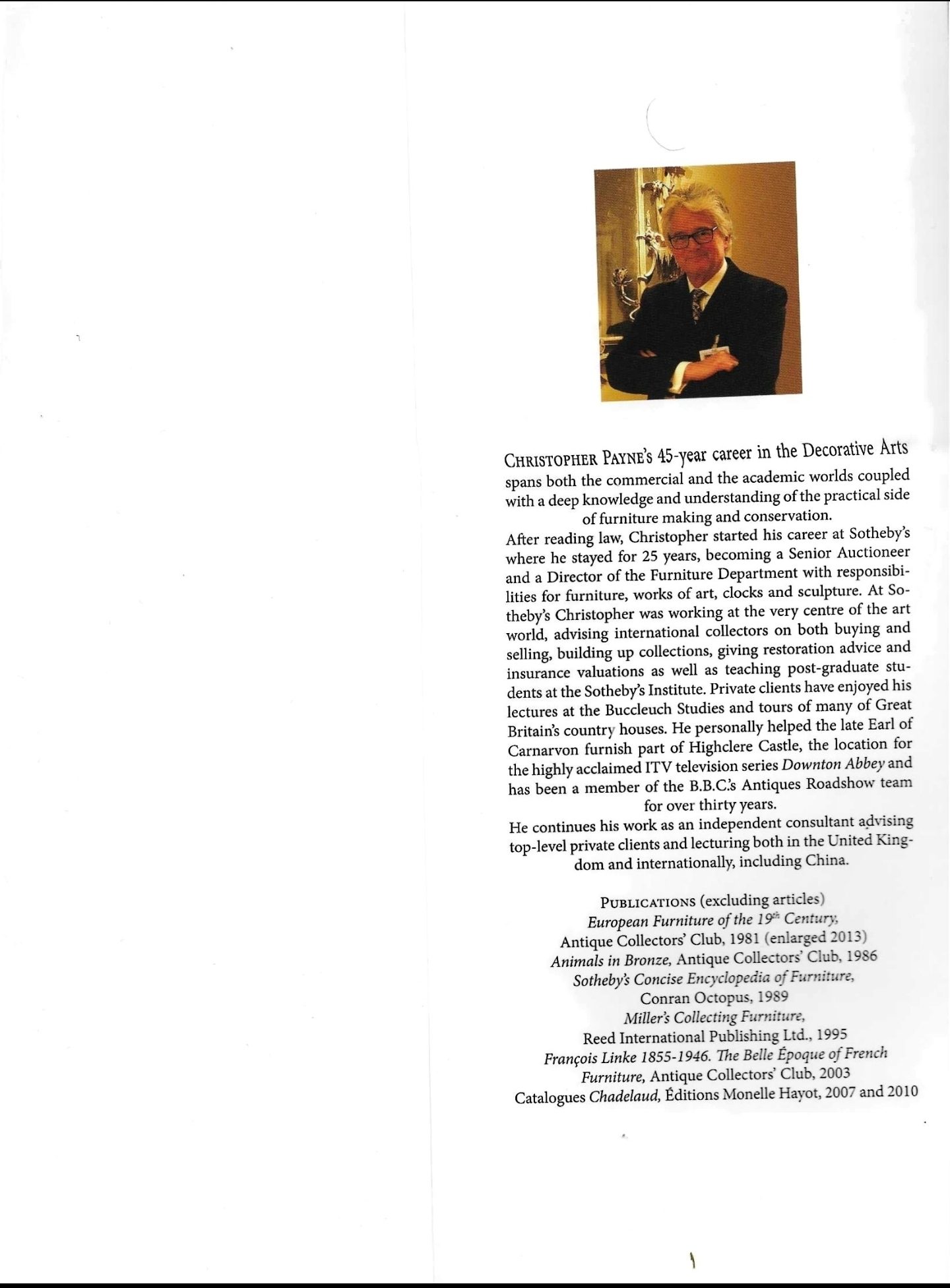
Christopher Payne — biographical page from Paris Furniture (2018)
Christopher Payne enjoyed a 45-year career in the Decorative Arts, spanning both the commercial and academic worlds with a deep knowledge of furniture making and conservation. After reading law, he started his career at Sotheby's where he stayed for 25 years, becoming a Senior Auctioneer and Director of the Furniture Department, advising international collectors on both buying and selling. He has been a member of the BBC's Antiques Roadshow team for over thirty years.
His publications include European Furniture of the 19th Century (1981, enlarged 2013), Sotheby's Concise Encyclopedia of Furniture (1989), Francois Linke 1855-1946: The Belle Epoque of French Furniture (2003), and the definitive Paris Furniture: the luxury market of the 19th century (Editions Monelle Hayot, 2018). He personally helped the late Earl of Carnarvon furnish part of Highclere Castle (the setting for Downton Abbey).
Source: Christopher Payne author biography, Paris Furniture (Editions Monelle Hayot, 2018).
Region: Manufactured in Paris, France. The Chardonnay atelier was a Parisian workshop, and the piece exhibits all characteristics of Parisian ebenisterie: the stamp format follows Parisian guild conventions; the ormolu mounts are consistent with Parisian foundry work; the material selection reflects the supply chains available to Parisian makers.
Age: c. 1860-1880 (approximately 146-166 years old). Dating is based on: stamp format and absence of JME mark (guild abolished 1791); material availability through colonial trade routes; ormolu gilding technique (mercury gilding, pre-electroplating dominance); veneer cutting evidence (machine-sawn, consistent with post-1850s production); and scholarly attribution by Christopher Payne within the Second Empire / Third Republic framework.
Report Reference
SG-FR-001-TECH-2026 · Prepared by Stitt Gallery Technical Department · 15 May 2026
This report is published in full as part of our commitment to transparent disclosure.
All assessments are based on photographic documentation and physical examination.
Independent expert verification is recommended for high-value acquisitions.
Authenticity & Provenance
This commode carries multiple original markers confirming its attribution to the Chardonnay atelier and its period of manufacture. Each is documented in the gallery's technical record.
Four circular Chardonnay estampilles, one stamped at each corner of the carcase, each bearing the family name interspersed with fleur-de-lys — consistent with the atelier's known marking practice.
The Chardonnay atelier signature appears in blue script on the underside of the marble slab — an additional workshop identifier found on pieces of elevated quality.
Hand-cut dovetail joints throughout the drawer construction, with Roman numeral assembly marks confirming original hand manufacture. Consistent with Second Empire Parisian workshop practice.
The Rouge Griotte de l'Hérault top is a single unjoined slab spanning the full 133 cm width, 30 mm in depth — an indicator of quality commissioning rather than commercial production.
All bronzes — corner sabots, drawer pulls, key escutcheons and apron cartouche — are hand-chiselled gilded ormolu. The quality of chasing and gilding is consistent with specialist Parisian bronze founders of the period.
Full technical documentation has been prepared by Stitt Gallery, including measured drawings, material analysis, photographic record of all estampilles, marble underside and internal construction.
The Estampilles
The four CHARDONNAY estampilles are the primary attribution marks on this commode. Each circular stamp bears the maker's name with a fleur-de-lys motif at centre — a pattern consistent with documented Chardonnay workshop practice.
Acquisition
Stitt Gallery offers several pathways for acquiring this piece, each suited to different timelines, risk profiles, and cost structures. We are happy to discuss which approach best serves your circumstances.
Option 1
Direct purchase from Stitt Gallery. The simplest and fastest route — no auction fees, no uncertainty. Typical timeline 3–6 weeks from enquiry to delivery. Full documentation included.
Option 2
Placement through a Parisian specialist auction house: Tajan, Piasa, Aguttes, or Artcurial. Suitable if you prefer market-tested pricing and are comfortable with the 15–25% buyer's premium and timing uncertainty.
Option 3
Placement through an established Parisian dealer or gallery on the Marché Biron or comparable venue. Offers curated presentation and access to a qualified collector base. Dealer commission typically 20–30%.
Market Context
The market for Régence Revival commodes by documented Parisian makers has shown consistent strength, with quality pieces from recognised ateliers maintaining value even through broader market fluctuations. The following ranges are based on comparable sales data from Tajan, Piasa, Aguttes, and Artcurial (2019–2024), adjusted for width, condition, and maker attribution strength.
Conservative
€18,000 – 28,000
High ConfidenceBased on auction results for comparable Chardonnay-attributed pieces in good condition. Suitable for auction reserve or quick private sale.
Moderate
€25,000 – 40,000
Medium ConfidenceReflects full retail replacement value and appropriate pricing for direct private sale to informed collectors with full documentation.
Optimistic / Dealer
€40,000 – 55,000
Lower ConfidenceAchievable through specialist Parisian dealers (Marché Biron, Galerie François Léage) with full restoration, exhibition provenance, and extended marketing.
€19,750
This piece is available for private sale. We welcome enquiries from collectors, interior specialists and institutions. Viewing by appointment in Poznań. Shipping to Europe and internationally arranged on request.
Secure online payment via Stripe · card · Google Pay
Gallery reference: SG-FR-001 · stittgallery.com
Continue Exploring